

Roundtable “Syria One Year After the Transition: Governing a Fragmented State”
Date of publication: February 5, 2026
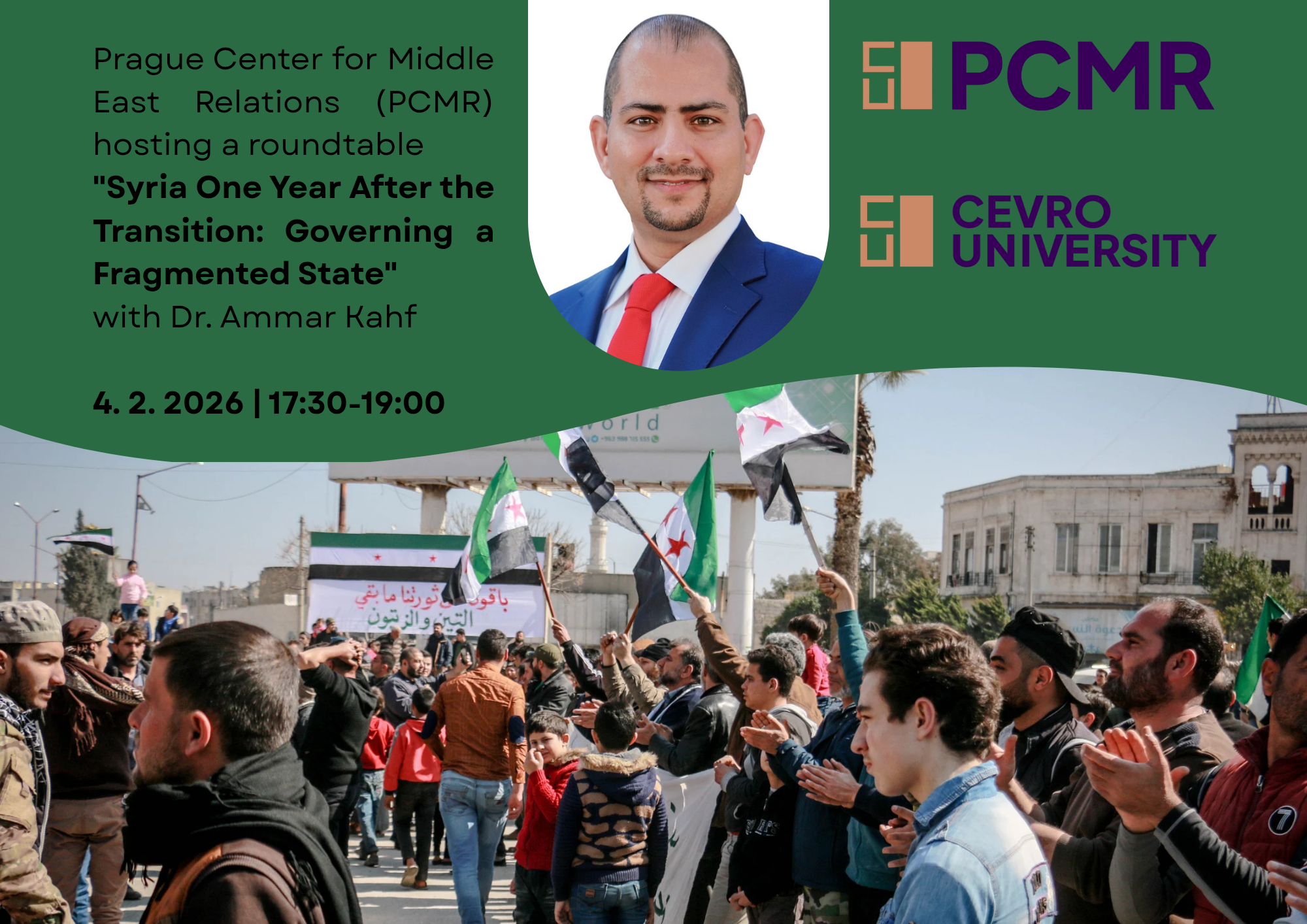
On February 5, 2026, the Prague Centre for Middle East Relations (PCMR) at CEVRO University organized a closed roundtable discussion “Syria One Year After the Transition: Governing a Fragmented State” with Dr. Ammar Kahf (a Co-founder and Executive Director of Omran Center for Strategic Studies).
The debate was moderated by Filip Sommer, Director of PCMR. The event was held under Chatham House Rules.
As part of the discussion, we focused on the issue of the transition of power in contemporary Syria, which continues to face profound political, economic, and security challenges. The authority of the Syrian interim government remains uneven across the country, constrained by weak institutional capacity, severe economic deterioration, and unresolved questions related to governance and legitimacy. While steps have been taken to consolidate control and project state authority, governance structures remain fragmented and are shaped primarily by security considerations rather than inclusive political processes.
We further discussed the position of ethno-religious minorities, including Alawites, Druzes, and Kurds. Minority communities continue to operate in an environment of uncertainty regarding political representation, security guarantees, and their role within the emerging post-transition order. In several areas, mistrust toward central authorities persists, reflecting both historical grievances and concerns about marginalization within the current political framework.
At the same time, the security situation remains unstable. Clashes between forces aligned with the Syrian interim government and the Syrian Democratic Forces (SDF) in late January 2026 point to ongoing disputes over territorial control (including oil fields), governance authority, and future political arrangements in northern and northeastern Syria. These confrontations underscore the fragility of the post-transition environment as well as the absence of a consolidated national security architecture.
Overall, Syria’s future trajectory remains uncertain. It is shaped by competing governance models, unresolved center–periphery relations, and persistent security tensions that continue to hinder stabilization and recovery.
Speaker’s Bio
Dr. Ammar Kahf is a Co-founder and Executive Director of Omran Center for Strategic Studies, a Syria-focused policy research center based in Damascus, Turkey and the USA. Dr. Kahf is also a co-founding Board Member of Syrian Forum, a civil society empowerment and development organization in Syria, Turkey, and the US. He earned his Ph.D. in Political Science and Islamic Studies, University of California, Los Angeles (UCLA). His dissertation research was entitled: Syrian Authoritarianism: Persistence or Change. His research work focuses on geopolitical alignments in the Middle East, the political process, and local governance in Syria. Omran regularly engages in local and regional dialogues and conversations on public policies that further the Syrian cause, elevates the voice of Syrians, and develops nuanced technical approaches to the peace process. Omran publishes papers with a whole-of-Syria approach on economic recovery, governance reforms, judicial and security reforms, social contract discourses, return of refugees, and military-civil relations.