

Roundtable “The US–Israel–Iran Conflict: Scenarios, Risks, and Regional Implications”
Date of publication: May 14, 2026
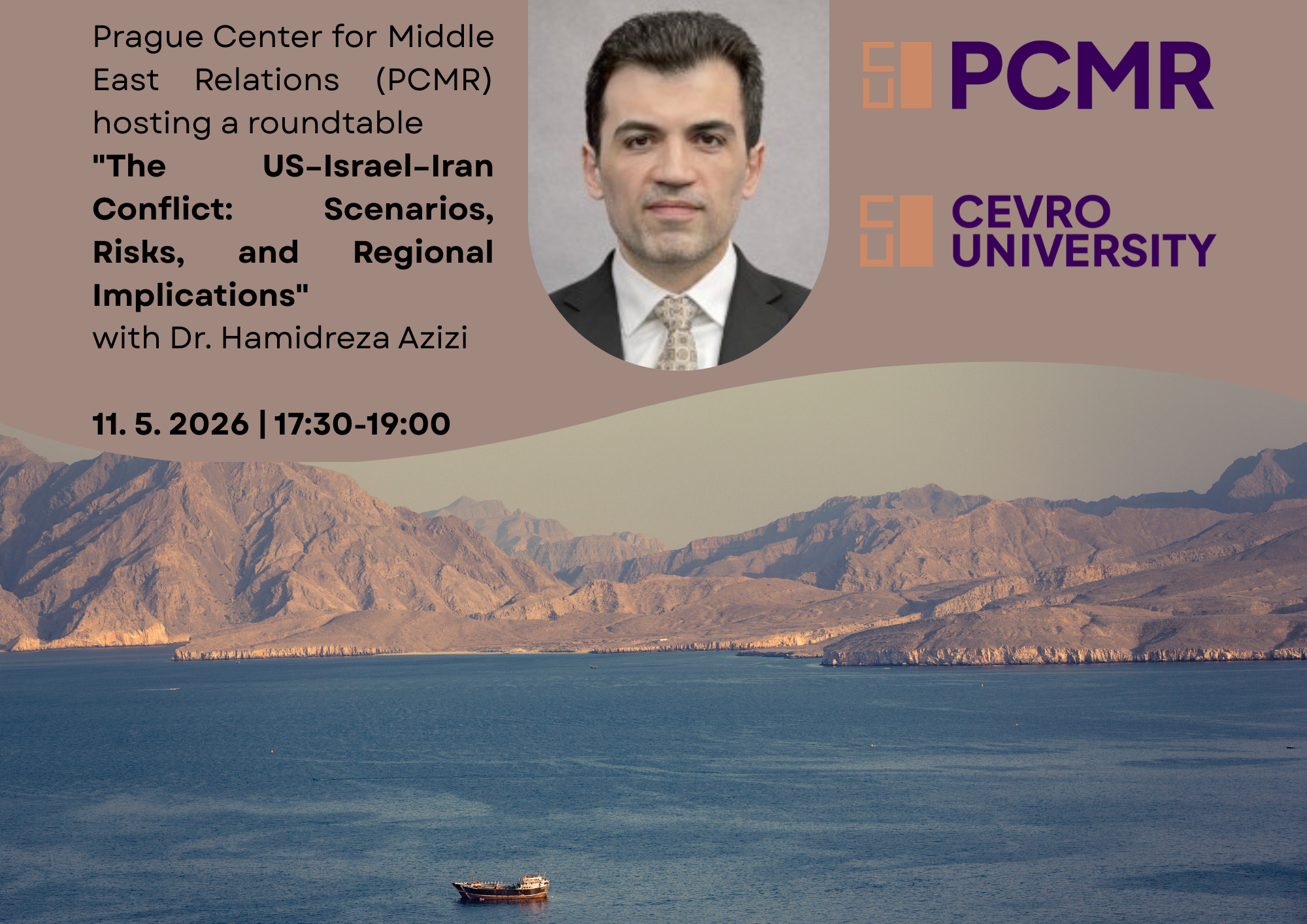
On 11 May 2026, the Prague Centre for Middle East Relations (PCMR) at CEVRO University organized a closed roundtable discussion titled “The US–Israel–Iran Conflict: Scenarios, Risks, and Regional Implications” with Dr. Hamidreza Azizi (Visiting Fellow at the German Institute for International and Security Affairs (SWP) in Berlin).
The discussion was moderated by Filip Sommer, Director of PCMR. The event was held under the Chatham House Rules.
During the discussion, we focused on the ongoing conflict between the United States, Israel, and Iran, which represents a significant shift from the long-standing model of indirect confrontation towards direct military engagement. The debate explored various dimensions of the conflict, its possible future trajectory, and its broader regional implications, particularly in the context of the coordinated US-Israeli strikes on Iranian territory launched on 28 February 2026.
The discussion addressed the strategic narratives and objectives of the Iranian regime, as well as the evolving dynamics of the confrontation across several key theatres. We discussed developments in the Strait of Hormuz, the impact of disruptions to maritime traffic on global energy markets, the continuing conflict in Lebanon, and the parallel security and political repercussions of the conflict in Iraq. Attention was also devoted to the ongoing diplomatic engagements in Islamabad and the broader prospects for regional de-escalation.
A significant part of the debate focused on possible scenarios of further escalation or, conversely, containment of the conflict, with particular emphasis on the future of Iran’s nuclear programme, issues surrounding uranium enrichment, and the related strategic objectives of the current Iranian establishment. We also discussed the internal distribution of political and decision-making power within Iran, including the strengthening role of the Islamic Revolutionary Guard Corps (IRGC) and the broader consolidation of hardline actors within the regime in the context of continuing conflict and external pressure.
Finally, we also addressed Iran’s relations with major external actors, particularly Russia and China, and discussed how these relationships may influence the future trajectory of the conflict, the regional balance of power, and the prospects for possible diplomatic de-escalation.
Speaker’s Bio
Dr. Hamidreza Azizi is a Visiting Fellow at the German Institute for International and Security Affairs (SWP) in Berlin. He also serves as an associate researcher at Clingendael – the Netherlands Institute of International Relations. He was an Assistant Professor of Regional Studies at Shahid Beheshti University (2016-2020) and a guest lecturer at the department of Regional Studies at the University of Tehran (2016-2018). His research interests include security and geopolitical issues in the Middle East and Central Eurasia, Iran’s foreign policy and Iran-Russia relations. He holds a Ph.D. in Regional Studies from the University of Tehran. His research focuses on security and geopolitical issues in the Middle East and Central Eurasia, Iran’s foreign and security policy, and Iran-Russia relations.
He regularly contributes to and is featured in leading international outlets, including CNN, Amwaj.media, Al Jazeera, Carnegie Endowment for International Peace, BBC, International Crisis Group, and Al-Monitor, among others. He is also the author of the Substack newsletter Iran Analytica, and his X account (@HamidRezaAz) has become a widely followed source for real-time insights on the evolving US–Israel–Iran confrontation.