

Policy Paper „The Islamic State under a new regional and security order in the Middle East”
Publication date: September 30, 2026
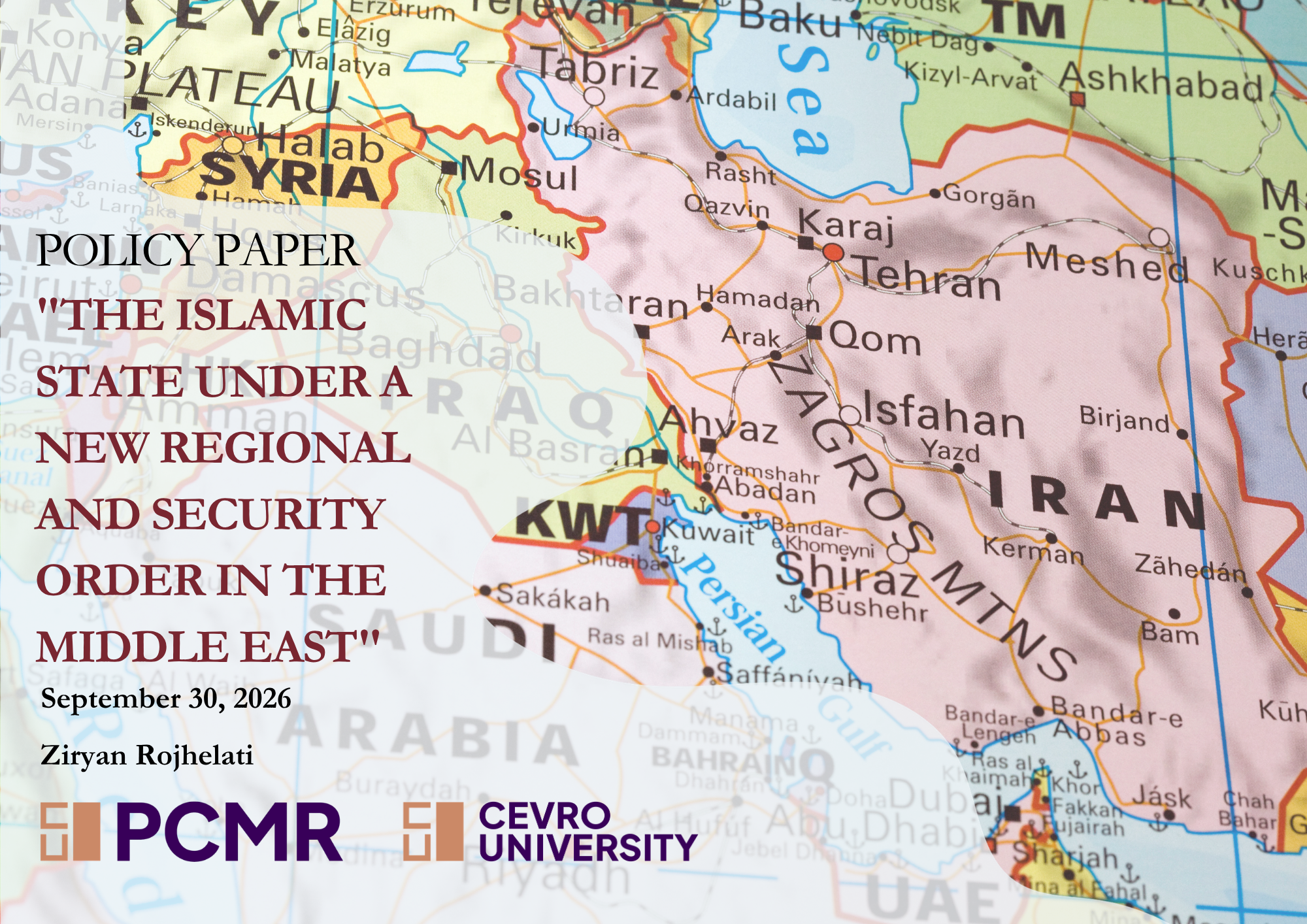
Ziryan Rojhelati, a research fellow at the Prague Center for Middle East Relations (PCMR) at CEVRO University, has published a policy paper entitled „The Islamic State under a new regional and security order in the Middle East”.
The Middle East is undergoing a significant transformation of its regional and security order. Changes in Syria, the restructuring of the international counter-ISIS architecture, the US military drawdown, the consequences of the US–Israel–Iran conflict, and shifting political and security dynamics in Iraq are creating a markedly different environment from the one in which the Islamic State (ISIS) established its territorial “caliphate” in 2014. The weakening of Iran’s regional position and the changing role of Iran-aligned actors further contribute to a broader reconfiguration of the regional balance.
Against this backdrop, Ziryan Rojhelati examines whether ISIS could exploit the emerging security environment to rebuild its operational capabilities. Despite its territorial defeat, the organization continues to operate through decentralized and clandestine networks in Iraq and Syria. The paper argues that the structural conditions that enabled ISIS’s rapid territorial expansion in 2014 no longer exist in the same form, making a return to its former territorial model unlikely in the short term.
At the same time, the emerging regional order presents new vulnerabilities. The restructuring of counter-ISIS operations, the withdrawal and repositioning of US and coalition forces, uncertainty surrounding Syria’s political transition, persistent security gaps along the Iraq–Syria border, and the potential spillover of the conflict with Iran could create opportunities for ISIS to preserve and adapt its underground networks.
The paper also places these developments within a broader transregional context. The growing importance of ISIS affiliates in Afghanistan and Africa demonstrates that the organization’s future can no longer be assessed solely through developments in Iraq and Syria. Rojhelati argues that ISIS’s trajectory will increasingly depend on the interaction between local security conditions and wider geopolitical developments stretching from Damascus and Tehran to Afghanistan and Africa.