Roundtable “Houthi Cross-border Networks and Operations: Implications on International Trade, Peace and Security”
Date of publication: October 10, 2025
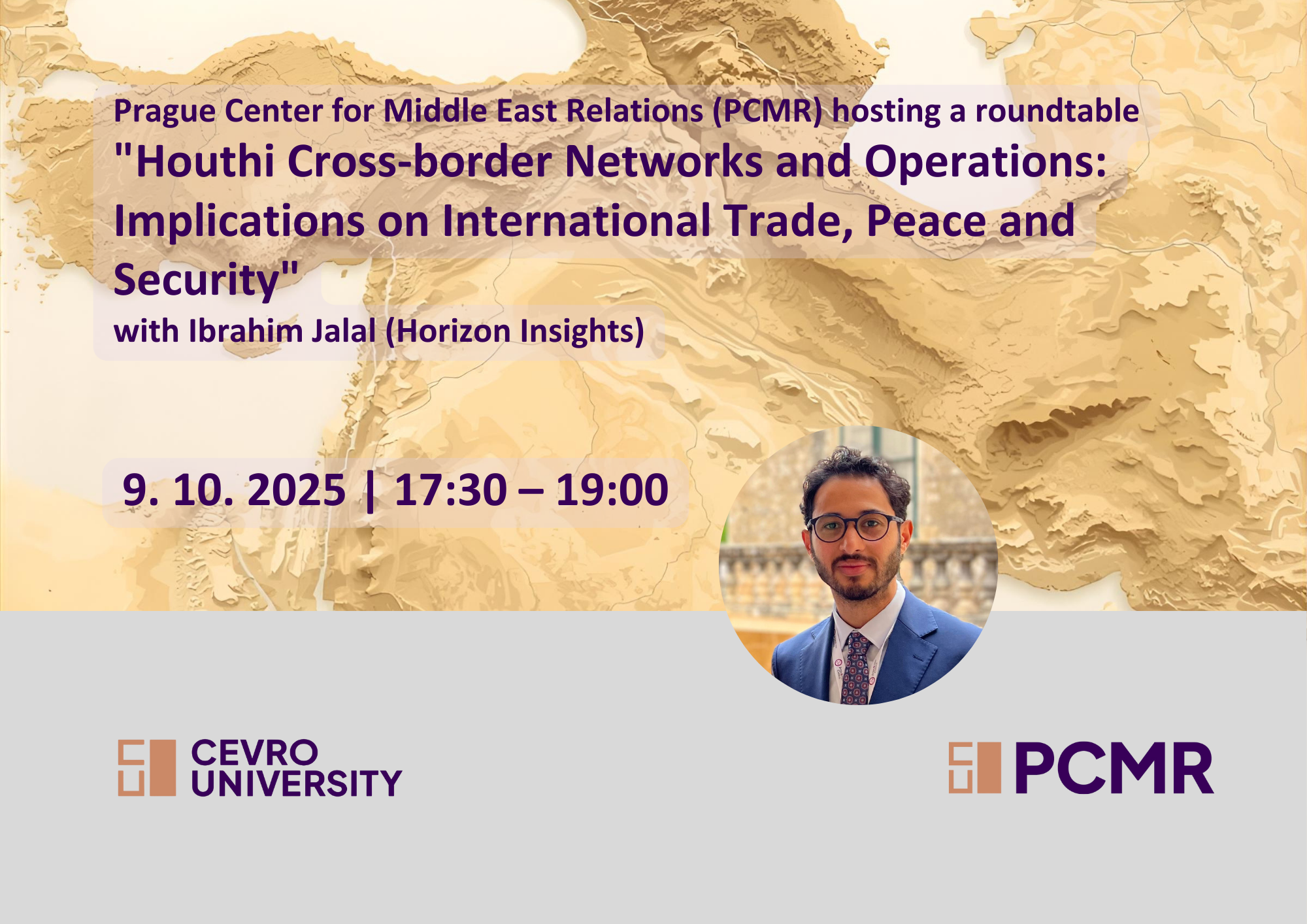
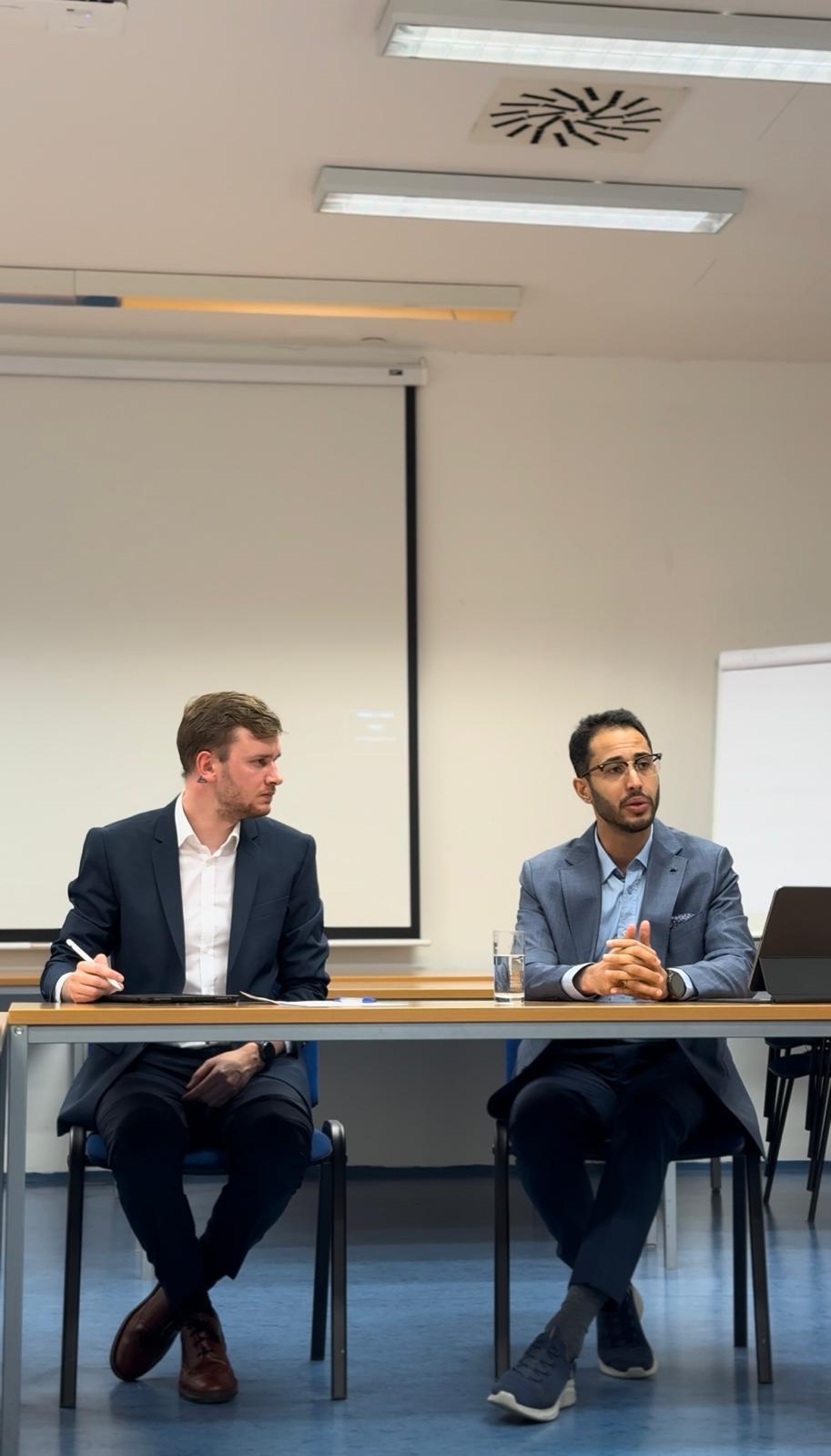
On October 9, 2025, the Prague Centre for Middle East Relations (PCMR) at CEVRO University organized a closed roundtable titled “Houthi Cross-border Networks and Operations: Implications on International Trade, Peace and Security” with Ibrahim Jalal, a senior analyst and policy advisor on the political, economic, and security dynamics of Yemen, the Red Sea, the Gulf of Aden, and the broader Arabian Peninsula.
The discussion was moderated by Filip Sommer, Director of PCMR, and the event was held under the Chatham House Rule.
The roundtable focused on the current geopolitical situation in Yemen and its implications for regional and global security. The debate emphasized that Yemen has become one of the most complex arenas in the Middle East, where over the past decade the internal power structure has undergone a profound transformation. The Ansar Allah (Houthi) movement has consolidated de facto control over the country’s northwest, including the capital Sana’a, thereby creating an alternative system of governance that operates in parallel and in opposition to the internationally recognized government.
The country is now deeply fragmented. While the Houthis dominate the northwest, the Southern Transitional Council (STC) controls much of the south, and other areas remain in the hands of tribal groups and local militias. This disintegration of authority has weakened the central government and intensified competition over Yemen’s future political order.
At the regional level, the conflict has become increasingly intertwined with Iranian influence, as Tehran provides the Houthis with weapons, strategic guidance, and ideological support. This has enhanced their military capabilities and positioned them as a key ally in Iran’s broader regional strategy, simultaneously threatening the security interests of neighboring Gulf states. The situation has been further escalated by Houthi attacks on maritime shipping in the Red Sea, including drone and missile strikes on commercial routes, which have disrupted international trade and maritime security. These developments have raised concerns about a potential renewal of Saudi and Emirati military operations in Yemen.
Finally, the discussion placed the Yemeni conflict within the broader context of the Middle East after Hamas’s October 7, 2023, attack on Israel. The region has undergone a profound geopolitical transformation: the war in Gaza has revived the centrality of the Palestinian question and led to closer coordination among Iran, Hezbollah, the Houthis, and Iraq’s Shiite Popular Mobilization Forces (PMF), thereby increasing the risk of a multi-front confrontation. Meanwhile, Gulf monarchies have adopted a cautious approach, seeking to balance security threats with the need to maintain stability and economic diversification.
Background
Yemen remains one of the most critical flashpoints in the Middle East’s evolving geopolitical landscape. The Ansar Allah (Houthi) movement has entrenched a de facto system of governance across much of north-west Yemen, directly undermining the authority of the internationally recognized government. This has entrenched the country’s internal fragmentation, producing rival centers of power in both the north and south and eroding prospects for a comprehensive national settlement.
Regionally, the Houthis’ alignment with Iran has significantly strengthened their military and political standing, embedding the Yemeni conflict within the broader network of regional rivalries. Their recent operations in the Red Sea, targeting commercial shipping lanes, have drawn international concern, raising the prospect of renewed Saudi and Emirati intervention on the ground. Long-range missile and drone attacks toward Israel further demonstrate the group’s expanding operational reach, escalating regional security tensions. Increasingly, Yemen also functions as a proxy front in U.S.–Iran confrontations, reinforcing its role as a pivotal arena in wider strategic bargaining.
Moreover, two years after Hamas’s October 7th attack on Israel, the Middle East has undergone a profound geopolitical reconfiguration. The Gaza war reshaped regional priorities, eroded momentum toward normalization between Israel and Arab states, and reignited the centrality of the Palestinian question in Arab politics. At the same time, Iran and its regional partners, including Hezbollah, the Houthis, and elements of the Iraqi Popular Mobilization Forces, have tightened its coordination. This has heightened the risk of a multi-front confrontation involving Israel, Lebanon, Syria, Yemen, and beyond. Meanwhile, Gulf monarchies have pursued a cautious recalibration: balancing security concerns over Iran and non-state actors with the need to maintain economic diversification and stability at home.
Speaker’s Bio
Ibrahim Jalal
Ibrahim Jalal is a Horizon Insights co-founder. Horizon Insights is a strategic consulting, research, and advisory boutique, based in Prague, and specialized in geopolitical risk, regional security, particularly in the Gulf and Yemen, conflict sensitivity, governance in fragile and conflict-affected states, and post-war reconstruction.
Jalal used to be a nonresident scholar at the Malcolm H. Kerr Carnegie Middle East Center, specializing in maritime security, conflict sensitivity, security and defense policy, and transitional peace processes. His research focuses on third-party-led peace initiatives, national dialogues, military coalitions, armed non-state actors, and the politics of social assistance. Notably, he examines Houthi regional networks in the Middle East and the African Horn, as well as maritime security in the Red Sea and Gulf of Aden.
His analyses have been featured by the Peace Research Institute Oslo, the Middle East Institute, and the Gulf International Forum. He has provided expert commentary on CNN, BBC, France 24, Al Jazeera, TRT, and RT.
Jalal’s accolades include awards from the Mahathir Global Peace School, the European Commission, HPAIR, Oslo University, the Nansen Center for Peace and Dialogue, the Dutch Ministry of Foreign Affairs’ One Young World, the Australian National University’s Asia Pacific Week, and the Cambridge Security Initiative.