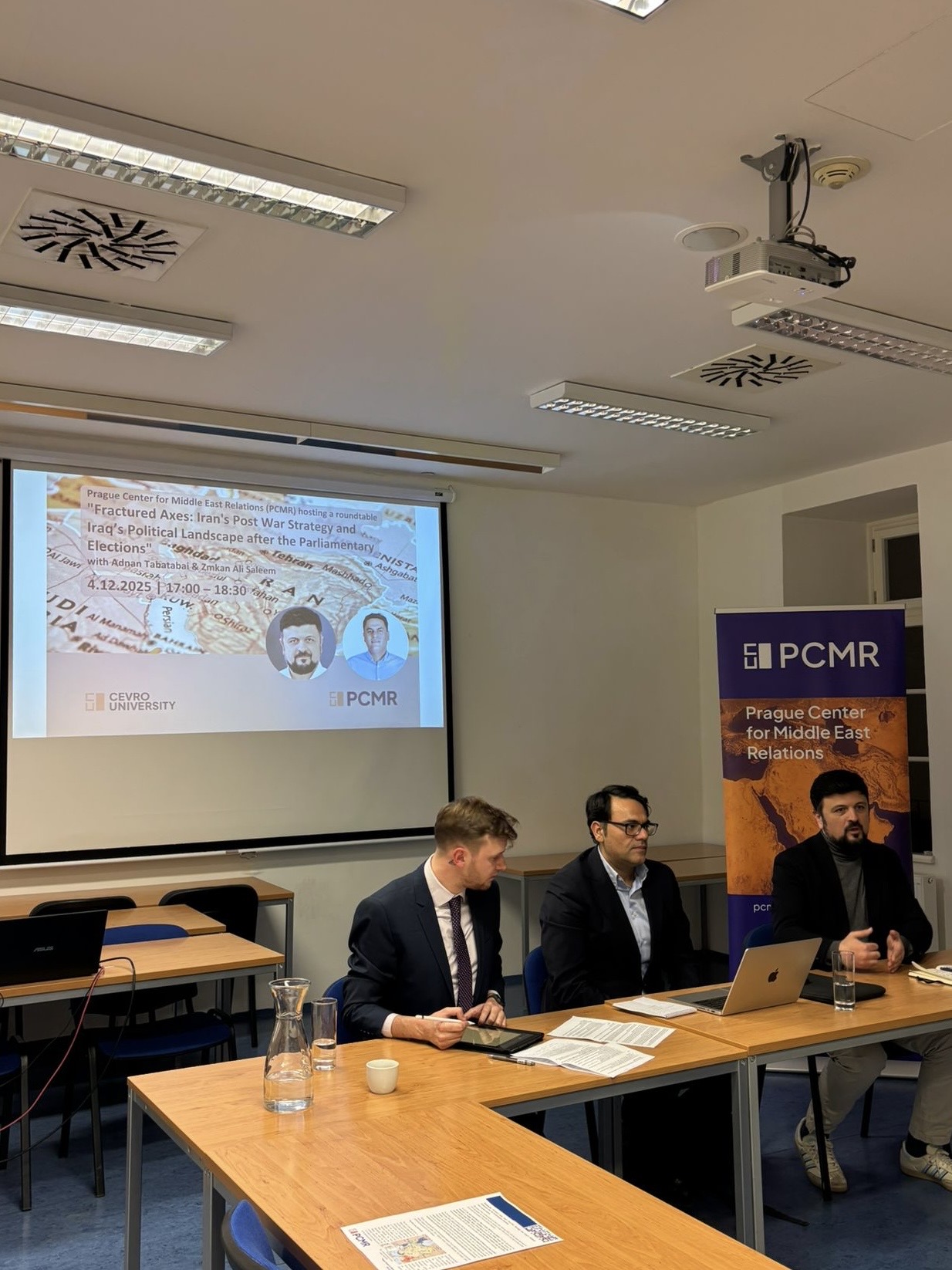
Roundtable “Fractured Axes: Iran’s Post-War Strategy and Iraq’s Political Landscape after the Parliamentary Elections”
Date of publication: December 8, 2025
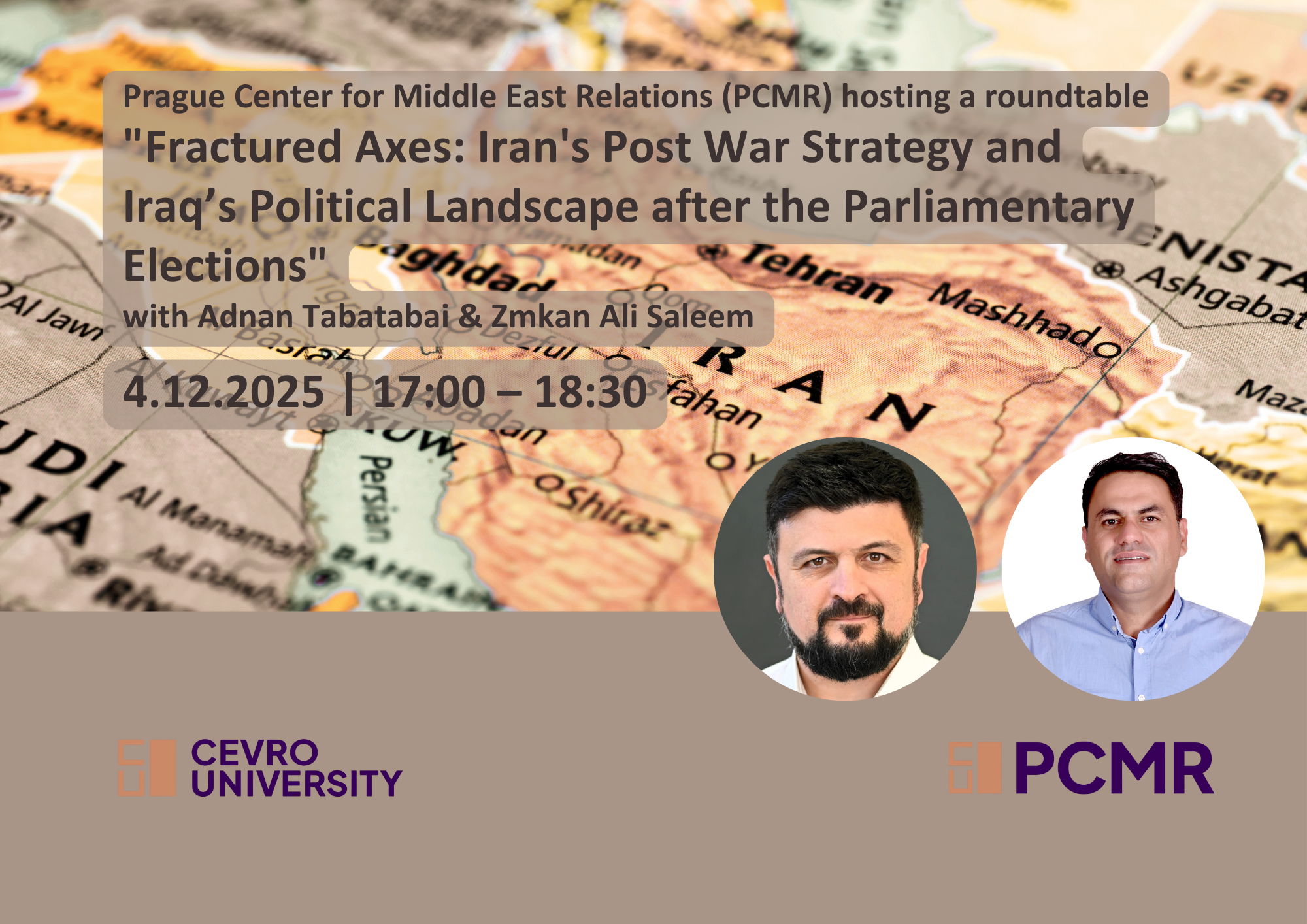
On December 4, 2025, the Prague Centre for Middle East Relations (PCMR) at CEVRO University organized a closed roundtable discussion “Fractured Axes: Iran’s Post-War Strategy and Iraq’s Political Landscape after the Parliamentary Elections” with Adnan Tabatabai (co-founder and CEO of the Center for Applied Research in Partnership with the Orient (CARPO)) and Zmkan Ali Saleem (Lecturer at the College of Political Science at the University of Sulaimani and Research Fellow at the Institute of Regional and International Studies (IRIS) at the American University of Iraq, Sulaimani (AUIS)).
The debate was moderated by Filip Sommer, Director of PCMR. The event was held under Chatham House Rules.
In the discussion, we focused primarily on the regional balance of power following Iran’s strategic setbacks in Gaza (through a weakened Hamas), Lebanon (due to continued pressure for Hezbollah’s disarmament), and Syria (which, after the fall of Bashar al-Assad’s regime on 8 December 2024, has been governed by a new Syrian interim administration led by President Ahmed al-Sharaa). This development was further shaped by the brief but significant 12-day war with Israel in June 2025.
Iran is undergoing a period of internal uncertainty driven by the looming question of succession to Supreme Leader Ali Khamenei, the rising assertiveness of hardline factions, and the trajectory of its nuclear program. Domestically, the state continues to rely on coercive stability amid persistent tensions with ethnic and religious minorities, including Kurds, Baluchis, Azerbaijanis, and the Bahá’í community.
We also discussed the implications of the Iraqi parliamentary elections of 11 November, which revealed deeper fractures within the Shia political landscape, where traditional parties, emerging movements, and armed groups are reassessing their strategies. These shifts are unfolding alongside the repositioning of Sunni and Kurdish actors and in the shadow of the evolving role of the muqawama factions (i.e., actors of the Iraqi resistance against the U.S. and Israel) within the broader Axis of Resistance. The legal and political future of the paramilitary Popular Mobilization Forces (PMF or Hashd al-Shaabi) remains unresolved, reflecting a wider dispute over the nature of the Iraqi state.
The debate further turned to Iran’s internal developments, the uncertainty surrounding the country’s leadership, economic pressures, and the re-evaluation of the security environment, all directly shaping dynamics in Iraq and influencing alliances, rivalries, and the strategic positioning of armed groups. Meanwhile, the United States maintains a limited yet still significant security and diplomatic presence, particularly in the Kurdistan Region of Iraq (KRI), while Russia and China are expanding their influence through energy, defense, and infrastructure projects.
Speaker’s Bio
Adnan Tabatabai is a co-founder and CEO of the Center for Applied Research in Partnership with the Orient (CARPO). He holds an MSc in Middle East Politics from the School of Oriental and African Studies (SOAS), University of London. As an Iran analyst, he advises European policymakers and businesses on Iran-related matters. In his role at CARPO, Tabatabai has designed and facilitated track-2 dialogue initiatives between Iran and Saudi Arabia since 2015. Additionally, he leads multi-track dialogues on regional security in West Asia and the Arabian Peninsula. He is the author of Morgen in Iran (October 2016, Edition Körber-Stiftung) and co-hosted the Iran podcast Digeh Che Khabar? (2020–2023). He covers topics such as Iran’s domestic and external affairs, regional security in West Asia and the Arabian Peninsula, dialogue and mediation, conflict prevention, and peace promotion.
Dr. Zmkan Ali Saleem is a Lecturer at the College of Political Science at the University of Sulaiman and a Research Fellow at the Institute of Regional and International Studies (IRIS) at the American University of Iraq, Sulaimani (AUIS). He previously served as the Director of Research at IRIS. During his tenure, Dr. Saleem has served as a lead researcher for projects funded by the FCDO, UNAMI, European Union, and the Norwegian Research Council, focusing on political economy in Iraq and Kurdistan. He holds a PhD in Politics and International Studies from the University of Leeds/UK. His doctoral research examined the domestic determinants of Iran’s regional security policies. Saleem’s later research examined the domestic and regional determinants of Turkey’s foreign policy toward the conflicts in Iraq and Syria. Saleem has contributed to the Fikra Forum at the Washington Institute for Near East Policy, where he focused on the issue of sectarianism in Iraq. His current research interests include the role of non-state security actors in shaping governance and stability in Iraq.