

Commentary on the current war in the Middle East
Date of publication: April 15, 2026
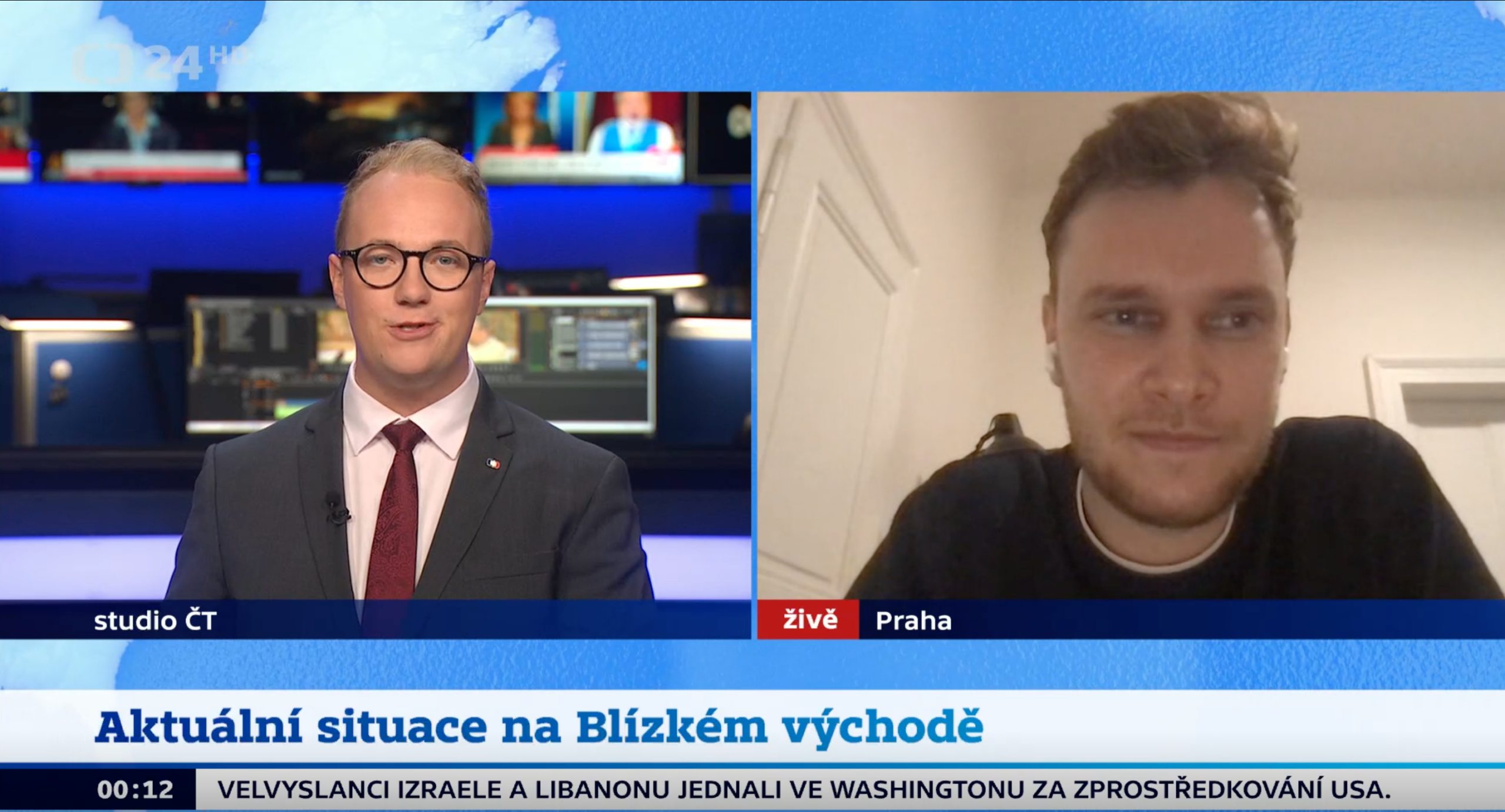
On April 15, 2026, Filip Sommer, Director of the Prague Centre for Middle East Relations (PCMR) at CEVRO University, commented for ČT24 on the current developments in Lebanon, including topics such as the disarmament of Hezbollah, ongoing negotiations between Lebanon and Israel, the evolution of Iran’s nuclear program, as well as the risks associated with a potential blockade of the Strait of Hormuz and its implications for both regional and global security. You can watch the full interview here (from 3:18).
Full transcript of the interview below
(Opening) Briefly, how readable is the current situation in the Middle East?
The situation is only readable to a certain extent—namely in terms of what the individual actors want, their general objectives, and their currently defined red lines.
The United States and Iran have fundamentally different visions of the region’s post-war order. Their demands currently appear difficult to reconcile, particularly when comparing the U.S. 15-point plan with Iran’s 10-point plan. While the U.S. demands a halt to Iran’s uranium enrichment, no nuclear weapons, the dismantling of the so-called Axis of Resistance, the reopening of the Strait of Hormuz, and the cessation of Iran’s ballistic missile program, Iran calls for the lifting of all primary and secondary sanctions, recognition of its control over the Strait of Hormuz, an end to attacks against Iran, and the withdrawal of all U.S. forces from the Middle East.
As for a potential agreement, it is worth noting that it took the Obama administration approximately two years to negotiate the nuclear deal with Iran.
At the same time, there are many additional factors that need to be monitored—not only developments along the U.S.–Iran axis, but also events in Lebanon, Iraq, the states of the Arabian Peninsula, and the Strait of Hormuz. These dynamics are interconnected and influence one another, all of which will shape future developments.
Negotiations between Israel and Lebanon in Washington are being described as historic—is this mainly because the two countries have been in a state of war for decades, or is there more behind this characterization?
In general, this is a type of meeting we have not seen for many decades. Its timing and the direct contact between diplomatic representatives of both countries are particularly important, as they are intended to serve as a preparatory phase for further negotiations. In the context of the ongoing conflict in the Middle East, I view this as an important first step toward de-escalation. Both sides have also agreed that the issue of Hezbollah must be addressed in some way.
How significant is the fact that Hezbollah is not at the negotiating table, and that its leader has rejected the talks?
Hezbollah is a central issue in these negotiations—specifically the process of its disarmament, which was set as one of the mechanisms within the ceasefire agreement in November 2024. The current leader of Hezbollah, Naim Qassem, has not only rejected the talks, but other representatives have also stated that they will not respect any potential future agreement between Israel and Lebanon. So yes, this is highly significant, and the future of Hezbollah is closely tied to the future of Iran—at least from my perspective.
Israel conditions any progress on Hezbollah’s disarmament. How realistic is this demand, given that the Lebanese government has long struggled unsuccessfully to achieve this?
Israel has long been pressuring the Lebanese government—specifically the Lebanese Armed Forces—to disarm Hezbollah. However, this is not primarily a matter of force or the provision of weapons, but rather of inter-communal communication. It is also a gradual process that will take years, not weeks, especially considering that Hezbollah has been arming itself for over four decades. Israeli strikes on Lebanon may even have the opposite effect, providing Hezbollah with a justification to remain armed.
Lebanon, on the other hand, is calling for an immediate ceasefire. Are these positions so far apart that the Washington talks are likely to remain largely symbolic? What would need to happen for them to become substantive?
In my view, the first step should be a more active involvement of the United States in these processes and increased pressure on Israel. Further steps would include greater engagement of the Lebanese Armed Forces at the local level and the conclusion of a more comprehensive agreement between the U.S. and Iran that would also include the issue of Lebanon. However, there are currently mixed signals as to whether Lebanon is, or will be, included in any broader U.S.–Iran agreement.
Fighting in southern Lebanon continues even during the talks. How much does this undermine the credibility of diplomacy and the chances for de-escalation?
That is a very good question. As I mentioned, this has so far been more of a preparatory phase, which should be followed by further negotiations. In my view, de-escalation will require the involvement of additional actors—not only the United States, but also Iran. While Washington can exert pressure on Israel, Iran has a significant influence on Hezbollah’s decision-making.
External actors—from the U.S. to France to Turkey—are also heavily involved. Who currently has the greatest influence on developments between Israel and Lebanon?
Undoubtedly, the United States remains the most influential actor, as it has leverage over both sides. France is also historically a key player that has long attempted to mediate conflicts in the region. Rather than Turkey, I would highlight the role of some Arab Gulf states, such as Qatar and Saudi Arabia. The United States has also reportedly approved $59 million for humanitarian programs related to internally displaced persons in Lebanon following the recent conflict.
It has been a week since the ceasefire between the U.S. and Iran was announced. How fragile is it—if we can still even speak of a ceasefire given the blockade of Hormuz ordered by Donald Trump?
I would describe it as very fragile. I would still refer to it as a ceasefire as long as there are no direct clashes between the two actors. However, any local trigger could lead to renewed confrontation, which, in my view, neither side actually desires.
Tehran has long indirectly indicated that if it is unable to export its oil, it will attempt to prevent other countries in the Arabian Peninsula and the Middle East from doing so. While Saudi Arabia currently uses alternatives such as the East-West pipeline to transport oil to Red Sea ports, and the United Arab Emirates uses the Fujairah pipeline to bypass the Strait of Hormuz, Iran could activate parts of its proxy network, particularly the Houthis in Yemen. Their activities could disrupt the Bab al-Mandab Strait or target Saudi ports. Attacks on energy infrastructure in these countries could also continue.
Israel claims that the ceasefire with Iran does not apply to Hezbollah. To what extent is this a legitimate interpretation? Could it be seen as a way to maintain operational freedom?
Israel perceives Hezbollah as an immediate threat. Here, perspectives diverge. For Iran, Lebanon serves more as a bargaining chip within the broader U.S.–Iran negotiations. In my view, unless Washington intervenes, Israel will continue its operations against Hezbollah across Lebanon. However, the impact of this on broader negotiations remains uncertain.
A key condition for the U.S. and Israel is the removal of enriched uranium from Iran. How achievable is this goal?
The United States and Israel have long emphasized that the removal of enriched uranium is crucial. However, its exact location is not entirely certain, with the nuclear complex in Isfahan often mentioned. Iran has consistently resisted such measures, and everything will depend on the decisions of its current leadership. Any potential special operation by the U.S. to secure the uranium would, in my view, be highly risky.
How central is Iran’s nuclear program to the current tensions?
It is absolutely central and represents one of the main objectives for both the United States and Israel. However, it is currently somewhat overshadowed by the issue of access to the Strait of Hormuz, whose blockade has global implications.
The U.S. and Iran are expected to meet again for negotiations in Islamabad. Do you see this as a genuine opportunity for progress, or rather as an attempt to buy time?
I believe both interpretations are possible. If both sides make concessions and find compromises, an agreement is achievable. If not, the ceasefire may serve merely as a temporary pause for regrouping and rearmament rather than a genuine step toward de-escalation. The conflict could therefore continue in recurring cycles of “escalation – ceasefire – negotiations – escalation,” and I believe both sides are preparing for such a scenario.
The humanitarian situation in Lebanon is deteriorating rapidly, with hundreds of thousands displaced. Could this pressure force the actors toward compromise, or does it risk further radicalizing the conflict?
I am concerned it is more likely the latter. Internal displacement in Lebanon may create new forms of tensions, particularly between displaced Shiite communities and other ethno-religious groups such as Sunnis, Christians, and Druze. A local conflict could easily escalate into a civil war, something the country has experienced in the past.
What will be key to watch going forward?
Certainly developments in the Strait of Hormuz, the situation in Lebanon, statements by U.S., Israeli, and Iranian leaders, and of course further rounds of diplomatic negotiations in Islamabad.