

Roundtable “Who Holds the Guns? Armed Groups and State Power in Syria and Iraq”
Date of publication: November 5, 2026
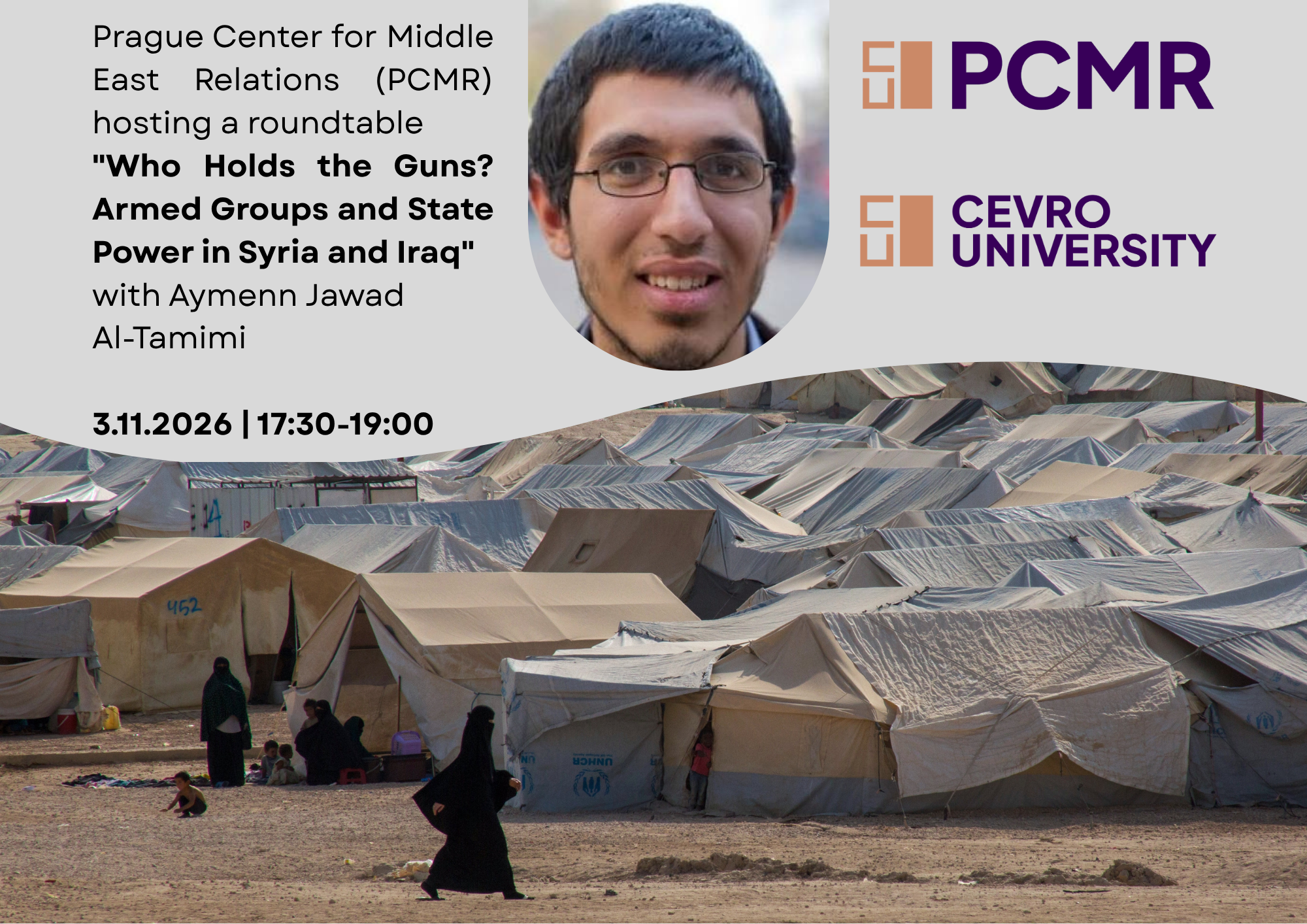
On 3 November 2026, the Prague Center for Middle East Relations (PCMR) at CEVRO University organized a closed roundtable discussion titled “Who Holds the Guns? Armed Groups and State Power in Syria and Iraq” with Aymenn Jawad Al-Tamimi, an independent analyst specializing in armed groups operating in Syria and Iraq, with a particular focus on jihadist organizations, especially the Islamic State (ISIS).
The discussion was moderated by Filip Sommer, Director of PCMR. The event was held under the Chatham House Rules.
The event focused on the changing relationships between state institutions and non-state armed actors in Syria and Iraq, particularly on the challenges associated with restoring state authority, integrating armed groups and ensuring effective control over security structures.
A significant part of the discussion was devoted to the security situation in Syria following the fall of the Assad regime, in particular the question of the future status of foreign fighters, some of whom had previously been active in Islamist armed groups. Their integration into the newly emerging military and security institutions represents one of the challenges of the ongoing political transformation. The discussion also focused on the international pressure being exerted on the Syrian leadership with the aim of regulating the presence of foreign fighters, strengthening state control over armed groups and preventing individuals linked to extremist organisations from holding influential positions within security structures.
Attention was also paid to the persistent threat posed by Islamic State (ISIS), which, even after the loss of its territorial caliphate, continues to operate through decentralised networks in Syria and Iraq. The discussion focused on its operational capabilities and the risk of a resurgence in its activities as a result of security vacuums, political uncertainty and weakened local administrative structures.
In the case of Iraq, the discussion focused on the current status of the Popular Mobilisation Forces (PMF), their relationship with the federal government, and the influence of factions linked to Iran. Particular attention was paid to issues of institutional autonomy, command structures and the accountability of individual armed groups. The possibilities for strengthening state oversight, and the potential restructuring or disarmament of certain groups, were also discussed, particularly in the context of pressure from the United States to limit the autonomy of pro-Iranian factions.
One of the central themes of the round table was the question of the extent to which the formal integration of armed groups into state structures actually contributes to strengthening government control, or whether, on the contrary, it may allow them to retain their de facto autonomy. The discussion also addressed how domestic political dynamics and the influence of foreign actors affect efforts to consolidate state authority, and what consequences these processes may have for the future stability of Syria and Iraq.
Speaker´s bio
Aymenn Jawad Al-Tamimi is an independent analyst specializing in armed groups operating in Syria and Iraq, with a particular focus on jihadist organizations, especially the Islamic State (ISIS). He is also an independent Arabic translator and editor. He graduated from Brasenose College at the University of Oxford and earned his Ph.D. from Swansea University, where his research examined the role of historical narratives in ISIS propaganda. His research focuses primarily on Iraq, Syria, and jihadist organizations, particularly ISIS, whose internal documents he has been collecting and archiving for many years. Al-Tamimi has worked with institutions such as The Washington Institute for Near East Policy, the Middle East Institute, the Middle East Forum, the International Centre for Counter-Terrorism, and the Konrad Adenauer Stiftung. He is also the author of the Aymenn’s Monstrous Publications newsletter on Substack. He has also published an Arabic translation and scholarly study of the Latin work Historia Arabum, the oldest surviving Western book devoted to Arab and Islamic history. His expert analyses and commentary have been cited by numerous prominent media outlets, including The New York Times, The Wall Street Journal, and Agence France-Presse (AFP).